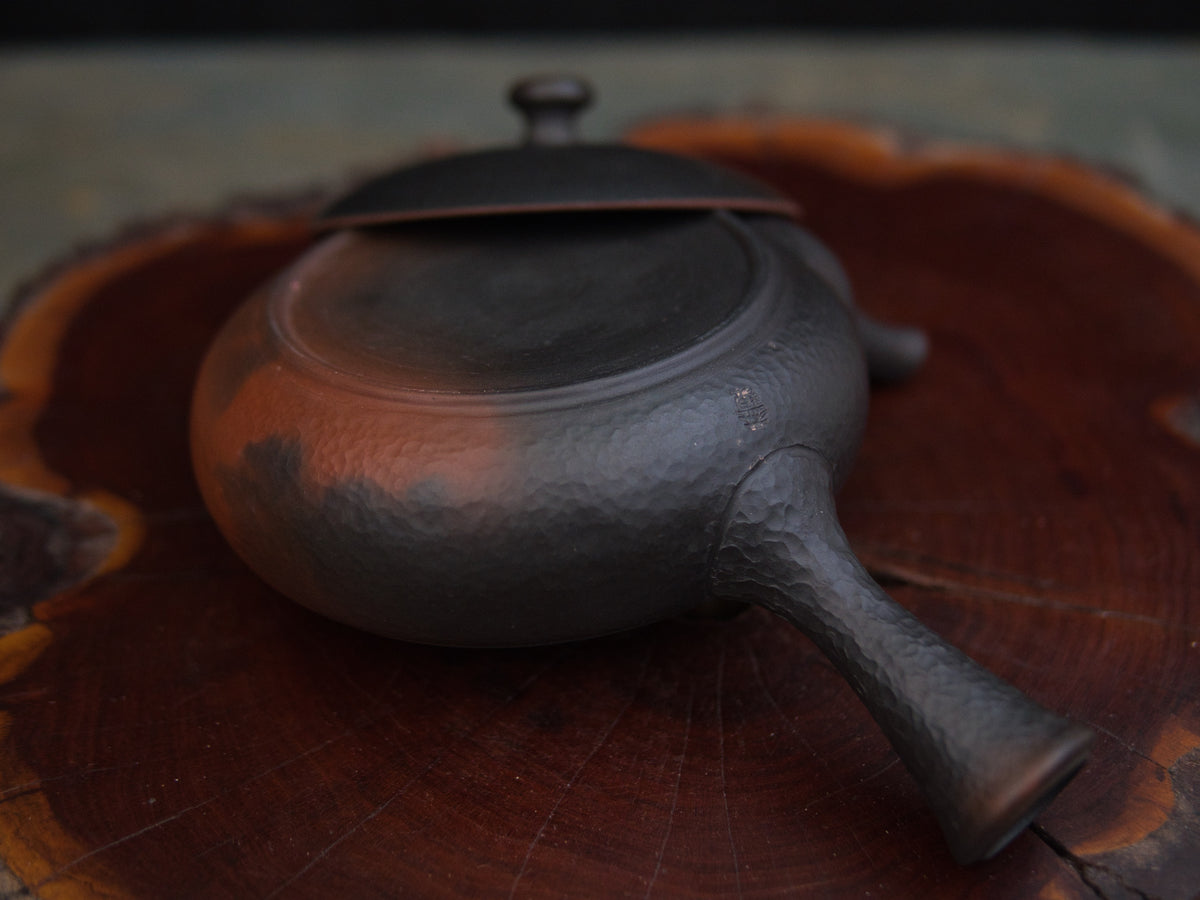
Yoshiki Kyûsu 220 ml
Yoshiki Kyûsu 220 ml
With a capacity of 220 ml, this teapot is perfect for preparing high-quality shade-grown teas such as Kabusecha or Sencha. The two-tone coloring is created by a fluctuating kiln atmosphere, also known as yôhen. The red area appears differently with each firing, so variations may occur. The elaborately crafted surface is uneven and, in addition to its visual appeal, has an intriguing tactile dimension. The artist is Murata Yoshiki, who was born in Tokoname in 1950 and has been producing mainly tea ceramics in his own kiln since 1973. He has participated in numerous exhibitions and has used the artist name Yoshiki since 1979. This high-quality teapot comes in a signed wooden box (tomobako).
Tokoname is the oldest of the “Six Ancient Kilns.” Ceramics have been fired in today’s Aichi Prefecture since the year 1100. In the early days, potters focused on producing unglazed utilitarian ceramics. Around 1200, with approximately 3,000 kilns, it was Japan’s largest ceramics center.
In 1840, the first potters in Tokoname attempted to imitate Yixing ceramics using iron-rich clay. Red shudei ceramics require the finest fraction of a highly iron-rich clay found beneath rice paddies.
When it was discovered that tea tasted better when brewed in Tokoname utensils, demand grew. From 1860 on, Tokoname potters attempted to copy the polished surface of Yixing ceramics. In 1877, they succeeded with the help of the Chinese scholar Jin Shi Heng and other specialists. The surface of the teapot must be carefully polished with a metal spatula to compact the clay. Today, Tokoname is known for the colorful variety of side-handle teapots (kyûsu). In addition to modern shapes, designs, and colors, traditional red teapots are also produced, which, like their Chinese predecessors, may be decorated with poems.
Pflegehinweise
Pflegehinweise
Nicht mit Spülmittel reinigen, nicht in Spülmaschinen-geeignet.
Low stock: 1 left