Fûgetsu Honshudei Kyûsu 110 ml
Fûgetsu Honshudei Kyûsu 110 ml
Stoneware
This kyûsu is a special commission within a small series that I exclusively commissioned. Pots are usually much larger, so at the request of many, I commissioned a smaller one.
The potter behind this simple kyûsu is Murakoshi Fûgetsu (村越風月), who was born in Tokoname in 1950. Fûgetsu studied under Yamada Jôzan (山田常山), who was awarded the title of "Living National Treasure" (人間国宝): an honor that only a few artists can claim.
Unlike mass-produced pots, this pot was fired from iron-rich natural clay that Fûgetsu prepared himself. This is a rarity in itself, as the natural clay deposits in Tokoname are almost completely depleted. In Tokoname, this natural clay is called honshudei (本朱泥). Because of the natural clay, the red color of the body appears somewhat paler in direct comparison. The charm of this pot lies primarily in the linear throwing marks created by turning it on the potter's wheel. This gives it a "soft" appearance and feel. This is also a hallmark of Fûgetsu.
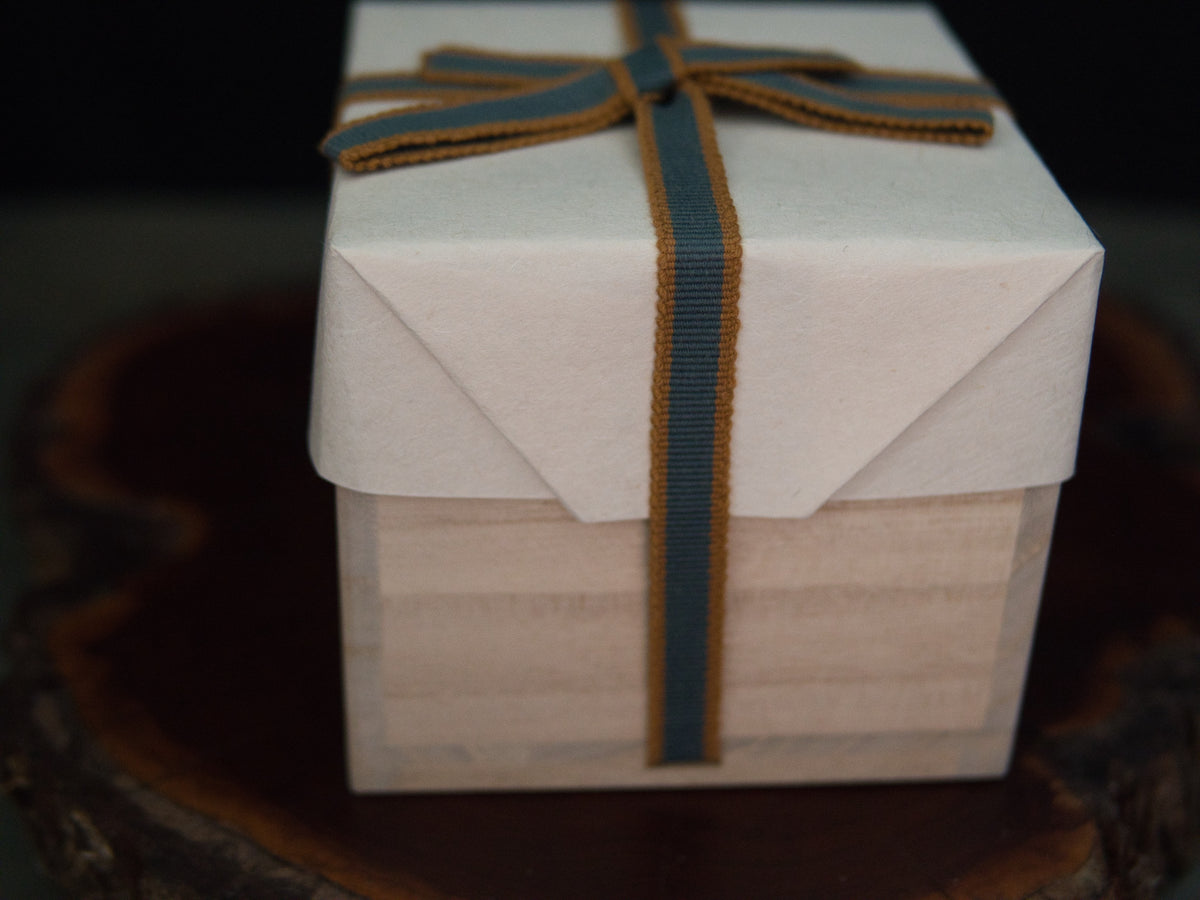
This kyûsu can be used to brew all types of green tea, but it is less suitable for Fukamushi-Sencha, as the ball strainer can become clogged by the high proportion of broken leaves in this variety. In the oxidation firing, the clay changes color and takes on a beautiful reddish hue. This pot comes in a signed wooden box (tomobako).
Tokoname is the oldest of the "Six Ancient Kilns". Ceramics have been fired in today's Aichi Prefecture since the year 1100. In the early days, potters focused on producing unglazed utilitarian ceramics. Around 1200, with approximately 3,000 kilns, it was Japan's largest ceramics center.
In 1840, the first potters in Tokoname tried to imitate Yixing ceramics using iron-rich clay. Red shudei ceramics require the finest fraction of a very iron-rich clay found under rice fields.
When it was discovered that tea tasted better from Tokoname utensils, demand grew. From 1860, Tokoname potters tried to copy the polished surface of Yixing ceramics. In 1877, they succeeded with the help of the Chinese scholar Jin Shi Heng and other specialists. The surface of the pot must be carefully polished with a metal spatula so that the clay compacts. Today, Tokoname is known for the colorful variety of side-handle pots (kyûsu). In addition to modern shapes, designs, and colors, traditional red pots are also produced, which, like their Chinese predecessors, can be decorated with poems.
Pflegehinweise
Pflegehinweise
Nicht mit Spülmittel reinigen, nicht in Spülmaschinen-geeignet.
Low stock: 1 left